Gifu University English Center
The English Center is an innovative, coordinated department that equips Gifu University students with the English skills to help them thrive in the wider world.
岐阜大学イングリッシュ・センター
Gifu University English Center
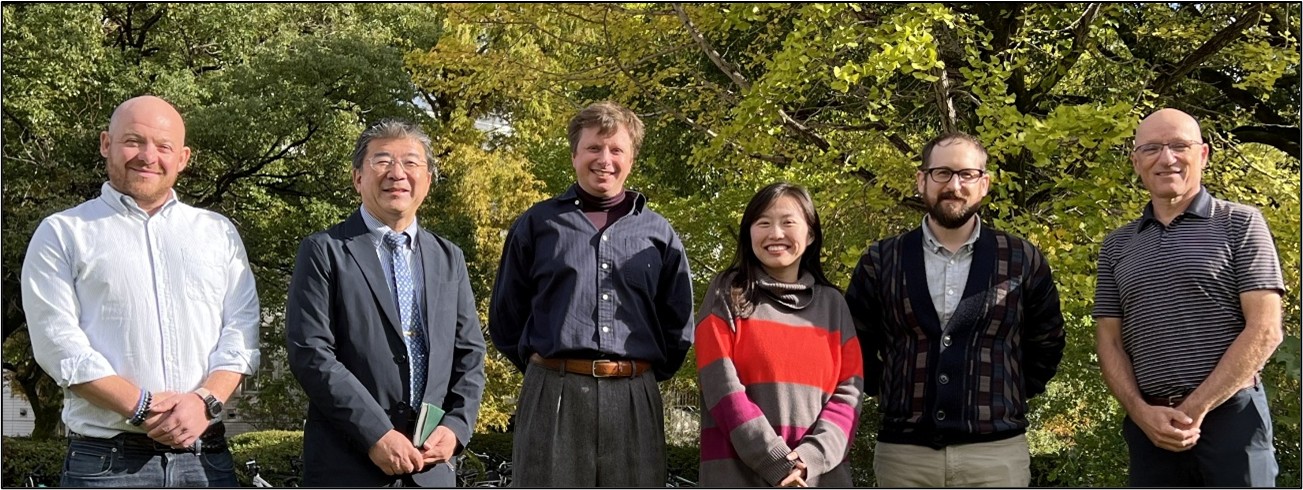
Established in 2018, the Gifu University English Center is responsible for standardizing the curriculum and evaluation criteria for English, which is a core subject for the entire student body. It also manages and supports part-time lecturers and responds to student inquiries. The Center is composed of Professor Chise Kasai of the Faculty of Regional Studies, five full-time faculty members, and seven part-time lecturers, who together are responsible for almost all English classes across all faculties. Through its original, in-house developed curricula, the Center delivers high-quality English education focused on practical application of the key language skills of speaking, reading, writing, and listening. At weekly meetings, the Center discusses operational policies, exchanges information among faculty members, and works on improving course content and developing teaching materials. In addition, through its English Xtra service, the Center offers students the opportunity to meet one-to-one with teachers for assistance in preparing for extracurricular examinations, advice on study abroad options, or practice in English conversation in a welcoming atmosphere.
The core concept behind the English Center is that all Gifu University students should have access to the same high standard of English education. To this end, all lessons are carefully developed and coordinated by the full-time faculty members. By incorporating the skills and experience of all Center members and maintaining close communication with part-time instructors, consistency in class content and student evaluation criteria is ensured, continuously assessed, and improved.
As a result, every student should complete their English courses equipped with the skills that will serve them well in the future. In addition, though the primary focus of the courses is the development of English language ability, there is also an emphasis on transferable skills. Thus, students not only see their English proficiency improve but also gain techniques that they can apply in their other fields of study.
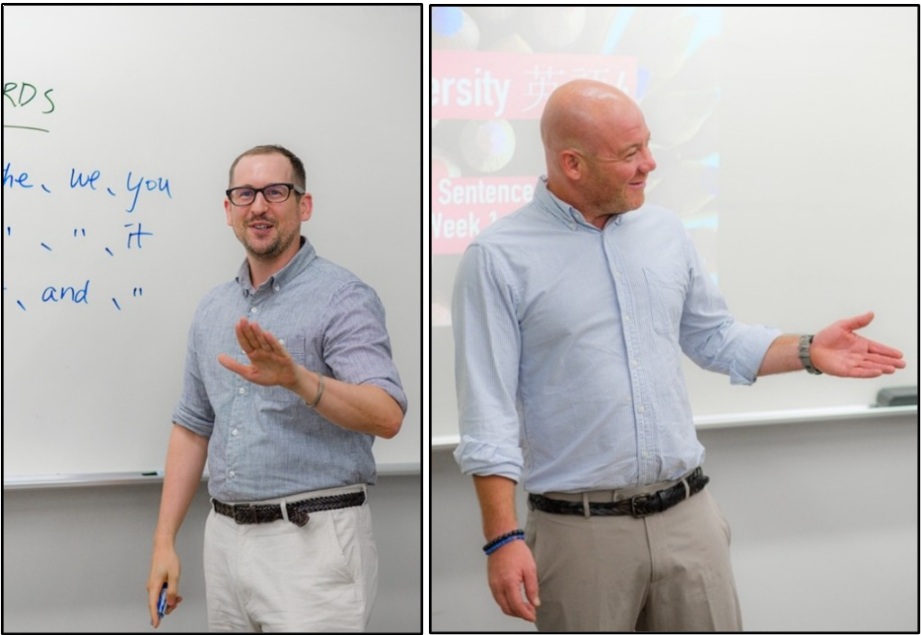
One of the biggest challenges in English education is that many students believe they are “bad at English.” The English Center aims to dispel this notion through the creation of practical lessons that build student confidence and make them think, “Maybe I can do this.” In the listening and reading classes, this is achieved by not only teaching techniques that show how to improve their skills but also explaining why those techniques work, providing meaningful context to their development. In the writing course, students not only improve their ability to write in English but also learn how to create academic essays—key transferable skills—as well as how to responsibly use and learn from cutting edge-tools such as generative AI. In the speaking course, students are taught to express themselves in a way that English Center research has shown to increase confidence. Furthermore, all classes incorporate group and pair work so that students can actively participate in classes while their motivation and confidence grow.

Through these innovative practices, the English Center strives to equip all Gifu University students with a functional and practical command of English that they can use effectively throughout their university life and beyond.
Guidelines and Basic Policies of the English Center at Gifu University
| Three Guidelines | Three Basic Policies |
|---|---|
|
|
Technology-specific curriculum
| English 1 Speaking |
English 2 Listening |
|---|---|
| The goal is to acquire English conversation skills that allow you to respond flexibly when approached by someone you meet for the first time. Focusing on improvisation when faced with unexpected responses, students will gain confidence in conversation through thorough practice. | In order to understand native English, it is important to understand pronunciation: “if you can say it, you can hear it”. Therefore, students will relearn the accent and rhythm of words and aim to reach a level where they can accurately understand words they already know. |
| English 3 Reading |
English 4 Writing |
|---|---|
| In addition to learning the relationship between spelling and pronunciation through the English learning method known as “phonics,” students will learn how to study words with multiple meanings, how to use dictionaries, and how to infer meaning from context, thereby cultivating the ability to read and understand English passages on their own. | Learn the basics of English writing and develop academic-style essays. Rather than simply translating Japanese into English, students understand the basic structure of English sentences, while developing techniques by which they can clearly communicate ideas in a clear and structured manner. |
Interviews with faculty members:
We want to offer higher-quality classes by encouraging active discussion among faculty members.

In addition to teaching English classes, I also provide support to part-time lecturers. With the opening of the English Center, part-time lecturers have become more open to sharing their thoughts and ideas about teaching, enabling them to offer more advanced classes. Teachers have also become more active in communicating with each other, and I am often asked for advice on teaching methods, such as “How can we make classes more interesting?” I feel that the improvement of the teaching environment has had a significant impact. Going forward, I anticipate that the synergistic effects among faculty members will lead to even higher-quality classes.
I aim to give students an open and inviting environment that encourages them to explore.

I find that students in general, as they grow older and shed their childhood whimsy, start to close themselves off to possibilities. Whether that be potential job prospects, future educational opportunities, or even just expanding upon what they already know, it seems as if something starts hedging them in and they lose some of that curiosity and wonder. Yet, they are still so young with so much life to experience! It is my hope that if I am able to provide them with an environment where they feel safe to explore and make mistakes, that would generate motivation to learn, and not just the topics written in the textbook.

